How we got here
On this page
- 1. A panel that was more open than it looked
- 2. Finding the way in: FEL
- 3. Mainline U-Boot, and the DRAM bug
- 4. Persistent root with Magisk
- 5. The installer, moved into the browser
- 6. Making it a good wall panel
- 7. The radio
- 8. The wall base
- The research notes
- General (docs/research/)
- Aqara S1 Plus (frames/aqara-s1-plus/)
- lululemon Studio Mirror (frames/lululemon-mirror/)
- Generic Android (frames/generic-android/)
- Ground rules for these notes
This is the engineering story behind S1 Unleashed: how a sealed Aqara wall panel became an open Home Assistant device that installs from a browser. The front page says what it does. These notes say how it works and how we found out, with the evidence.
You don't need any of this to use the project. It's here for people who want to check the work, extend it, or port it to another panel.
Contents
- A panel that was more open than it looked
- Finding the way in: FEL
- Mainline U-Boot, and the DRAM bug
- Persistent root with Magisk
- The installer, moved into the browser
- Making it a good wall panel
- The radio
- The wall base
- The research notes
1. A panel that was more open than it looked
The S1 Plus is an Allwinner A133 board running Android 10, with an Aqara launcher on top. The
first step was the panel's 3-pin debug UART: 3.3 V, 115200 8N1, reached through flat pads that
need a firm or soldered contact. An ESP32-S3 served as the USB-to-UART bridge
(tools/esp32-uart-bridge).
The stock boot log, captured over that console, showed how little was locked down:
secure enable bit: 0                                  ← secure boot off
tool did not set rotpk burn flag, skip rotpk burn     ← no root-of-trust key fused
magic = AVB0 ... release tool = avbtool 1.1.0         ← verified boot present, not enforced
A root shell confirmed the rest: SELinux was permissive, an AOSP su shipped in
/system/xbin, and the build was test-keys. The chip would boot unsigned code. The
remaining question was how to reach it without a serial cable.
→ hardware.md · boot-log.md · findings.md
2. Finding the way in: FEL
Every Allwinner SoC has FEL, a USB recovery mode in mask ROM. It can't be erased, and on this panel it isn't authenticated. That makes the panel very hard to brick for good: you can always get back into FEL.
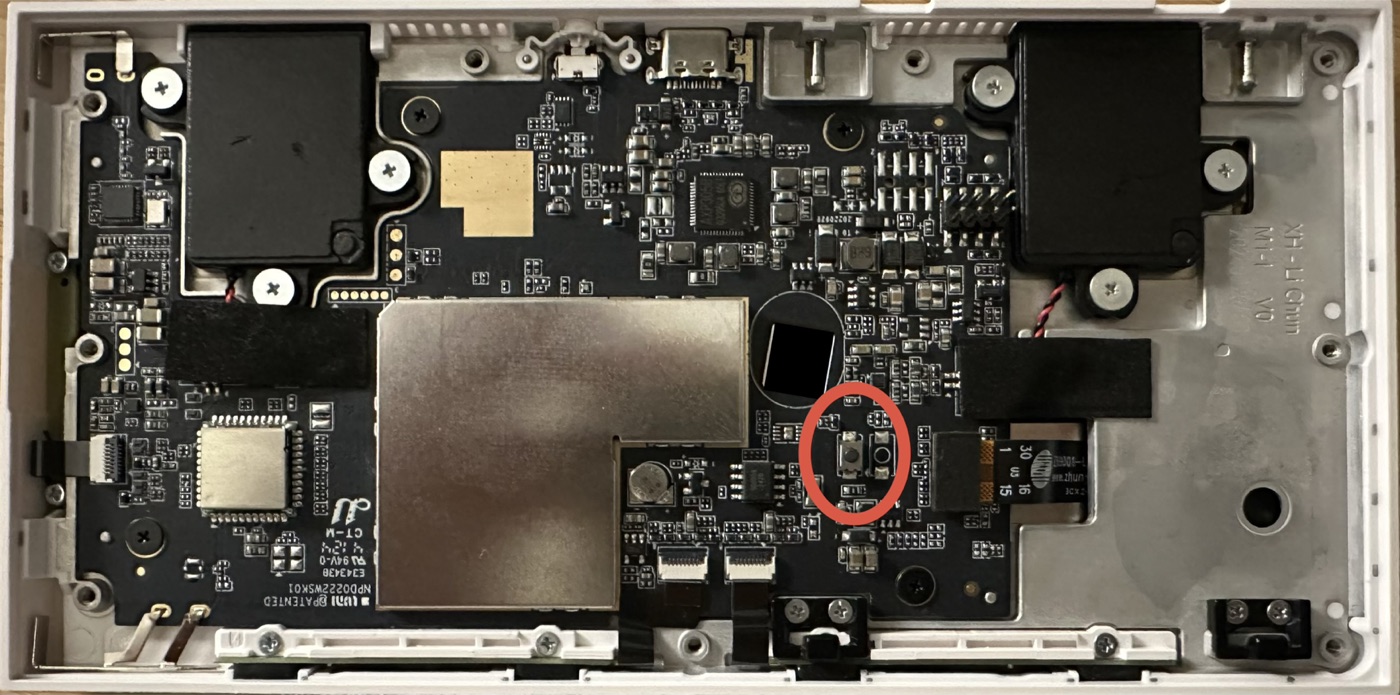
Before settling on FEL, which needs a button on the board, we looked hard for a way in with no
button. The stock U-Boot opens a USB gadget on every boot (usb burn from boot). Reading the
BSP source showed it is a key-burning mode: it has a ~700 ms window, vendor SCSI opcodes,
and no way to flash partitions. Every other route (efex via misc, the RTC FEL flag,
auto_fel) needs root on the panel first. So the PCB button became the one physical step:
open the back cover, hold the button, plug in USB-C.
→ findings.md: Bootloader USB entry points
3. Mainline U-Boot, and the DRAM bug
To flash anything over USB, we needed our own bootloader running from RAM. That meant mainline U-Boot with a board config for the panel, using the real DRAM parameters read from the stock BOOT0 header (DDR4, 792 MHz, 1200 mV, AXP806 PMIC).
It "worked": 2 GiB came up and passed every write-then-read test. Then real code crashed at
random. TF-A hit undefined instructions on valid opcodes, memcpy hung, and crash dumps came
out garbled. A copy loop (load from one address, store to another) found the pattern: about
300 corrupted 64-bit words per MiB, all on read→write bus turnarounds.
To find the cause, we diffed the DRAM controller registers two ways: as our SPL programmed
them (read over FEL), and as stock boot0 programmed them (read from Android through
/sys/class/sunxi_dump). Six differences stood out:
| Register | Mainline | Stock | Why it mattered |
|---|---|---|---|
MR0 (INIT3 + MRS) |
0x840 |
0x520 |
The RAM ran a different CAS latency than the controller assumed |
MSTR bit 0 |
geardown on | off | The DRAM's own MR3 has geardown off |
INIT7 (MR6) |
0x826 |
0x862 |
A typo |
DRAMTMG6 |
0x00000005 |
0x02020005 |
0x20 << 16 truncated to 0 |
ADDRMAP1/ADDRMAP8 |
0x1f |
0x3f |
"Disabled" in 6-bit fields |
SCHED[3:0] |
0x1 |
0x5 |
With all six matched to stock, everything booted. A bisect then showed that MR0 alone is the fix: without it, U-Boot hangs even with the other five changes; with only MR0, a copy test of 16 MiB passes 12 times out of 12. The other five just match boot0. This likely affects every A133 board with DDR4, so the MR0 fix goes upstream as a single patch. Three smaller fixes followed:
- CPU clock. The CPU is pinned to 408 MHz, because there is no SPL driver for the AXP806.
- USB uploads. These go in 64 KiB chunks, because the boot ROM's USB is slow at that clock.
- No TF-A. U-Boot runs straight at EL3 for now.
Then came fastboot over USB-C, plus a small upload extension to read partitions back
at about 20 MB/s.
→ fel.md · patches in frames/aqara-s1-plus/tools/fel/uboot/patches
4. Persistent root with Magisk
The radio modes need a root service, and the stock image makes that awkward:
- adbd drops the capabilities that Aqara's
suneeds. - The boot ramdisk is first-stage only.
- Changing
systemwould mean rebuildingsuper.
Magisk changes only boot, and its overlay.d injects an init service into second-stage
init. That is exactly what the S1 root helper needs. The app never gets su; it only sets
properties, and the init service does the root work.
- AVB. It turned out not to matter. The panel already boots a
vbmetawith verification disabled, even while it reportslocked, so a patchedbootjust boots. - First boot. A one-shot service authorises the installing computer's adb key, which is baked into the image, so adb comes up with no taps on the screen.
- Factory simulation. We wiped the reference panel back to factory state: adb off, keys
cleared, stock
boot, factoryvbmeta. One command then installed and verified everything, and adb was back 21 s after reboot. Re-running on a patched panel produces the identical image.
→ root.md
5. The installer, moved into the browser
The CLI chains sunxi-fel, fastboot, Docker and adb. The web installer does the same in
one page, over WebUSB:
flowchart LR
  A[FEL<br/>1f3a:efe8] -->|SPL + U-Boot to RAM| B[fastboot<br/>1f3a:1010]
  B -->|read partitions| C[Backup<br/>browser + .zip]
  C --> D[Patch boot<br/>in the browser]
  D -->|flash + read back| B
  B -->|reboot| E[adb<br/>Tango]
E --> F[S1 Kiosk, Wi-Fi,<br/>HA, radio]- FEL over WebUSB. A TypeScript port of the subset of
sunxi-felwe use:ver,splandreset64, uploading in chunks. - fastboot. Our gadget, plus the partition-read extension.
- A byte-exact Magisk patch. This was the hard part. magiskboot compresses with specific
Rust crates (
zlib-rsat level 9,lzma-rust2with an ARM Thumb BCJ filter), and neither the browser's gzip nor liblzma produces the same bytes. So those exact pinned crates are compiled to WebAssembly. The browser's output matches the CLI's Docker patch byte for byte, and the tests check it against golden images from the CLI. - adb over WebUSB. Tango (ya-webadb) installs the app and configures the panel. Wi-Fi credentials go over Improv Serial through adb.
The UI went through five mockups before option E, the one that shipped.
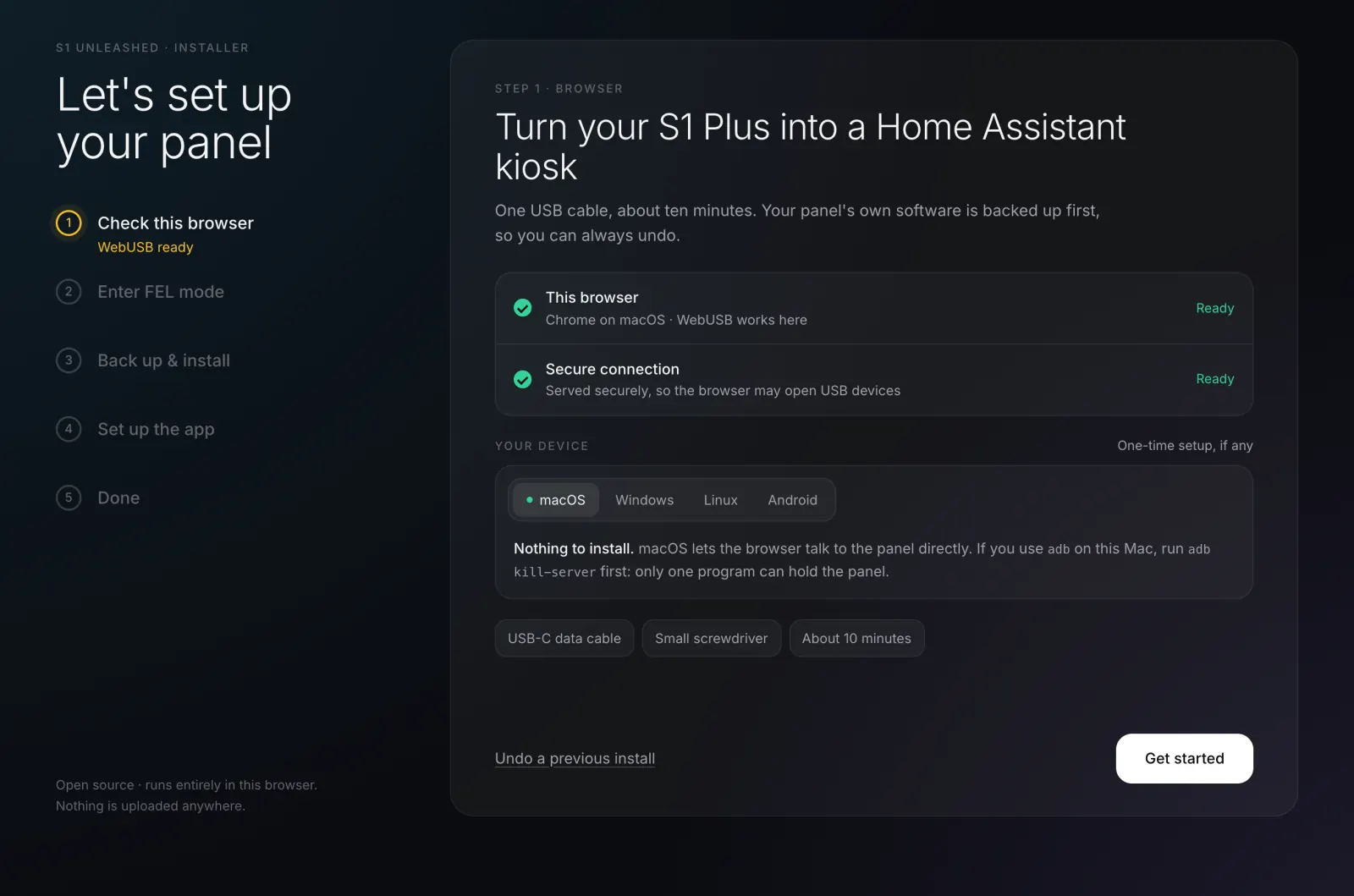
→ web-installer.md (the design spec, written before the build) · kiln/
6. Making it a good wall panel
- A browser that can run Home Assistant. The system WebView is Chromium 74. GeckoView ships its own current engine, so S1 Kiosk is built on it.
- The screen that turned itself off. At night the panel kept going dark, and it looked like a
kiosk bug. It was Aqara's system manager: a hidden Do Not Disturb rule from 22:00 to 07:00
forces the screen off 15 s after every wake. The panel had also shipped in the
Africa/Algierstime zone. The installer now turns that rule off through Aqara's own binder API, and the kiosk runs its own night mode, using the panel's time-of-flight and light sensors. → screen-policy.md · ../sensors.md - Aqara's cloud. Disabling Aqara's apps didn't stop it phoning home. A native daemon,
ha_master, kept the cloud link up. A watchdog in Aqara's system manager also forced a Wi-Fi reassociation whenever that link dropped. The kiosk stops the daemon at start, and the panel then holds no internet connections. → debloat.md - Voice. openWakeWord runs on the panel with TFLite. The ESPHome native API makes the panel an Assist satellite, and the Ambient Stage overlay shows the conversation.
7. The radio
The panel's 802.15.4 radio is a Silicon Labs EFR32. It sits on SPI and runs multi-PAN RCP
firmware over CPC. Aqara's stack is
cpcd → zigbeed (spinel IID 1) → EZSP → Z3Gateway → MQTT.
- Zigbee coordinator. Keep Aqara's
cpcdandzigbeed, and bridge EZSP to TCP so that ZHA on Home Assistant drives the radio over the network. - Thread. OpenThread's
otbr-agent, cross-built for the panel, talks to the same RCP on the free spinel IID 2. A full border-router build is still in progress, so this mode is experimental. - Routers. Zigbee router and Thread router modes shipped in 0.3.0 and joined a real home network on 2026-11-10 (experimental).
- Deliberately not offered: Zigbee and Thread at the same time on one radio. They would share a channel, and Home Assistant deprecated the same multiprotocol design on its own hardware.
The radio's firmware flash path was proven by reflashing the identical stock RCP image.
8. The wall base
The mains relay base talks to the panel over /dev/ttyS3. Its protocol was reverse-engineered
from Aqara's bracket_cli and libha_bracket.so, which are 32-bit ARM, stripped, and read with
llvm-objdump and radare2.
To check the result, we wrote an emulator from that reading and ran Aqara's own bracket_cli
against it on the panel. Aqara's tool accepted it. The kiosk's native driver passes the same
test, but it has not yet met a real base.
The research notes
This page is the index of every note. Notes about one device live with its frame, in
frames/<id>/research/; notes that apply to every frame live here, in docs/research/.
General (docs/research/)
| File | What's in it |
|---|---|
| bringup.md | The method: how to break into a device step by step, and what the S1 taught us about FEL, U-Boot, fastboot and Android 10 |
| TEMPLATE.md | Start a new note from this |
| microwakeword.md | Replacing openWakeWord with microWakeWord: the Kotlin port of TFLite Micro's audio frontend, the models, test speech, and what is left for the panel |
| gecko-turn.md | Gecko won't use a TURN server at a loopback IP or a relayed candidate on loopback (Chrome does): why the S1 never connected to Clarity's WebRTC camera, and the fix (#202) |
| ha-esphome-actions-events.md | What a notification can carry over ESPHome each way: why notify takes one JSON data argument, and why a tapped button goes to HA as a bus event, not an event entity (#118) |
| camera-presence.md | Which detector wakes the screen from a camera: ML Kit and a person model weighed, then the maintainer's lighting-insensitive motion detector chosen (#117) |
| onvif-rtsp.md | What HA's ONVIF integration and UniFi Protect need from a camera, the libraries weighed, the maintainer's tested RTSP and ONVIF server that Glassworks ports, and HA's pull loop on a refused sign-in, with a lab to rerun it (#117) |
| kiln-gpl-code.md | Which code in Kiln's MIT page comes from GPL projects: sunxi-tools in kiln/packages/fel, Magisk in kiln/packages/bootpatch, checked word by word and against the live site, with the options (open, a maintainer decision) |
| kiln-cleanroom/ | The clean-room rewrite of Kiln's GPL-derived FEL and boot patch code (#355): the rules, a behaviour spec for each package, and the black-box test vectors |
| pane-blueprints.md | How a pane's blueprints reach Home Assistant without the panel writing to it: HA's admin-only blueprint API, the import and list links, the name an import gets, and HA's own check of the four blueprints, with a script to rerun it |
| legacy-engine.md | The frozen GeckoView 144 on Android 6–7 (API 23–25): what runs, the API diff against 159, APK size per ABI, and the lockdown to the panel's Home Assistant, verified on emulators (#198) |
Aqara S1 Plus (frames/aqara-s1-plus/)
| File | What's in it |
|---|---|
| hardware.md | Board, SoC, FEL button, the 3-pin UART console and an ESP32-S3 as the adapter |
| boot-log.md | Annotated stock boot log: BOOT0 DRAM bring-up, secure-boot state, partitions |
| findings.md | Root, SELinux, AVB, partitions, USB/adb defaults; why there is no button-free USB entry |
| fel.md | Mainline U-Boot from FEL: the A133 DDR4 fix, CPU clock, chunked uploads, fastboot |
| root.md | Persistent root with Magisk, the root helper, first-boot adb provisioning, fel-install.sh |
| web-installer.md | The WebUSB installer's design spec: FEL port, fastboot, byte-exact boot patch, per-OS setup |
| screen-policy.md | Why the panel turned its screen off (Aqara's DND night rule) and what replaced it |
| debloat.md | Aqara's packages, the reversible de-bloat, and the cloud daemon and its Wi-Fi watchdog |
| bases.md | Which wall bases exist, how the panel talks to them, the kiosk's driver |
| base-protocol.md | The wall base UART protocol, with the emulator proof against Aqara's own tool |
| zigbee2mqtt.md | Zigbee2MQTT on the stock radio: Silicon Labs' zigbeed 8.2.2 on Aqara's RCP, panel tests, licences |
| rcp-firmware.md | Could a newer multiprotocol RCP be built for this MG21? CPC protocol, tooling, board config |
| framework-restart.md | Android 10's ActivityManager breaking during fast kiosk restarts, and system_server restarting; the likely (untested) cause of the panel "dropping off USB" |
| boot-animation.md | What Android 10's boot animation and the 32 MiB boot image allow: texture caching, trim, the size budget, and what was cut from the #63 design |
| idle-cpu.md | Why the kiosk uses ~40% of a core at idle: the wake word's embedding model, per-thread numbers, and the options (#105) |
| webrtc-camera.md | A real camera over WebRTC in GeckoView on the S1: it plays, very likely with software decoding (Gecko's FFmpeg) where HLS gets the hardware decoder (#202) |
| bluetooth.md | The panel's Bluetooth (RTL8821CS, shared with Wi-Fi), Android 10's scan rules from AOSP, and what HA needs from an ESPHome Bluetooth proxy (#121) |
| view-open.md | Where typical's 4.7 s view open goes: HA's JavaScript on one Gecko thread at 1.5 GHz; the app candidates tried on the panel (none helped), and what's left upstream (#244) |
| install-crash-loop.md | Why the kiosk crash-looped after installs: Android 10's ActivityManager LRU bug (one step per kiosk force-stop), not dex2oat; the netwatch check that restarts the framework (#248) |
lululemon Studio Mirror (frames/lululemon-mirror/)
| File | What's in it |
|---|---|
| mirror-android.md | Can the lululemon Mirror run Android 8+ for the current GeckoView? The signed boot image blocks it; the kexec idea, the paths, blobs and read-only probes (desk research, #39) |
| revisions.md | Which Mirror revisions are a target: the later NXP i.MX8 revisions (only JTAG access reported), and why screen size doesn't identify it (read, no hardware) |
| mirror-abis.md | Which ABIs the Mirror's userspace runs: 64-bit in the community image, stock untested (#98) |
| home-app.md | How adb without root makes S1 Kiosk the Mirror's home screen on Android 6: no cmd, so Android's chooser and an Always tap (read-only probes, 2026-11-15) |
| community-image-terms.md | May Kiln download and modify the community system image? No licence for its vendor binaries, no CORS; open for the maintainer (#40) |
Generic Android (frames/generic-android/)
No notes yet.
User-facing guides stay one level up, in docs/.
Ground rules for these notes
- No device-unique values: no serials, MACs, EUI64s, keys or PAN IDs. They are redacted wherever a log contained them.
- No Aqara binaries or firmware in the repository. Backups and dumps stay off-repo.
- Every claim is something we ran or read. Where something is untested, the note says so.